For yield-conscious savers and income investors in Zambia, choosing where to park cash reserves is a fundamental decision. For years, commercial bank Fixed Deposits (FDs) were the default choice for individuals, investment clubs, and corporate entities seeking low-risk interest returns.
However, as nominal yields on Government of the Republic of Zambia (GRZ) Bonds maintain historically high rates (often ranging from 14% to 18%+ per annum), more investors are comparing commercial bank fixed deposits against sovereign debt.
This guide provides a comprehensive head-to-head comparison between Fixed Deposits and GRZ Bonds across yields, safety, liquidity, taxation, and inflation protection to help you determine the best home for your capital.
Quick Comparison Summary
| Feature | Fixed Deposits (FDs) | GRZ Bonds | Winner |
| Issuer / Risk | Commercial Banks (Credit Risk) | Sovereign / GRZ (Sovereign Risk) | GRZ Bonds |
| Nominal Yields | Typically 6% – 12% p.a. | 14.0% – 18.5%+ p.a. | GRZ Bonds |
| Investment Horizon | Short-Term (30 days to 1 year) | Medium to Long-Term (2 to 15 years) | Depends on Intent |
| Payout Frequency | At Maturity (or Monthly/Quarterly) | Semi-Annually (Every 6 Months) | GRZ Bonds |
| Taxation | 15% Withholding Tax | 20% Withholding Tax + 1% BoZ Fee | Fixed Deposits |
| Rate Re-investment Risk | High (Rates reset at each renewal) | Zero (Coupon rate is locked for full term) | GRZ Bonds |
| Secondary Market Liquidity | Penalty fee for early termination | Tradeable on secondary market / LuSE | Fixed Deposits (for speed) |
1. Safety & Credit Risk: Bank Risk vs. Sovereign Backing
When evaluating where your cash sits, safety comes down to who is holding the liability:
- Fixed Deposits: Your principal relies on the financial health of the specific commercial bank issuing the deposit. While major tier-1 banks in Zambia are well-capitalized, your money is exposed to institutional credit risk. Furthermore, deposit protection insurance coverage limits in Zambia mean large balances face counterparty exposure if a small financial institution distresses.
- GRZ Bonds: Sovereign debt is backed by the full faith, credit, and taxing power of the Government of the Republic of Zambia. Because the central bank (Bank of Zambia) issues debt in local currency (ZMW), nominal default risk on domestic bonds is practically zero.
Verdict on Safety: GRZ Bonds carry lower credit risk than commercial bank deposits.
2. Returns & Lock-In Yields: The Impact of Interest Rate Risk
Yield is where the gap between FDs and GRZ Bonds becomes most pronounced.
Typical Yield Comparison
- Commercial Fixed Deposits: Most Zambian commercial banks offer fixed deposit rates between 6.0% and 12.0% per annum, depending on the size of the deposit, the bank’s liquidity needs, and your negotiation power.
- GRZ Bonds: Primary auction yields on GRZ Bonds consistently clear at 14.0% to 18.5%+ per annum depending on the tenor (2-year up to 15-year paper).
Locking Rate for the Long Term
The hidden advantage of GRZ Bonds is duration protection:
- If you lock in a 10-year GRZ bond at 16.5%, you are guaranteed that exact 16.5% gross yield every year for the next decade, regardless of whether national interest rates fall in 2027 or 2028.
- With a 1-year Fixed Deposit, if national interest rates drop next year, your bank will renew your FD at a significantly lower rate, forcing you to accept reduced income (re-investment risk).
3. Taxation and Net Cash Collections
Tax treatment differs slightly between commercial bank products and central bank debt instruments:
Fixed Deposit Net Yield:  Gross Interest - 15% Withholding Tax (WHT)
GRZ Bond Net Yield:       Gross Coupon   - (20% WHT + 1% BoZ Handling Fee)
Worked Calculation: K100,000 Investment
Let’s compare a high-yielding 1-Year Fixed Deposit at 11.0% against a 5-Year GRZ Bond at 16.0%:
Option A: K100,000 in a 11.0% Fixed Deposit
- Gross Annual Interest: K100,000 * 11.0% = K11,000
- Less 15% WHT: K11,000 * 15% = K1,650
- Net Annual Return: K11,000 – K1,650 = K9,350 (Effective Net Rate: 9.35%)
Option B: K100,000 in a 16.0% GRZ Bond
- Gross Annual Coupon: K100,000 * 16.0% = K16,000
- Less 20% WHT + 1% BoZ Fee (~21% Total): K16,000 * 21% = K3,360
- Net Annual Return: K16,000 – K3,360 = K12,640 (Effective Net Rate: 12.64%)
The Difference: Even after paying higher withholding tax on the bond, the GRZ Bond yields K3,290 more in net cash income per year on a K100,000 principal than the top-tier bank fixed deposit.
4. Liquidity & Access to Emergency Funds
- Fixed Deposits: Offer superior short-term flexibility. FDs can be structured for 30, 60, 90, 180, or 365 days. If you need emergency cash before maturity, banks will allow early liquidation, though they will charge an early-termination penalty fee or forfeit accrued interest.
- GRZ Bonds: You cannot walk up to the Bank of Zambia and redeem your principal prior to the bond’s maturity date. To exit early, you must sell your paper on the secondary market (via a commercial bank or LuSE stockbroker). While secondary market trading exists, finding a buyer at par value can take days or weeks depending on prevailing market demand.
The Verdict: Which One Should You Choose?
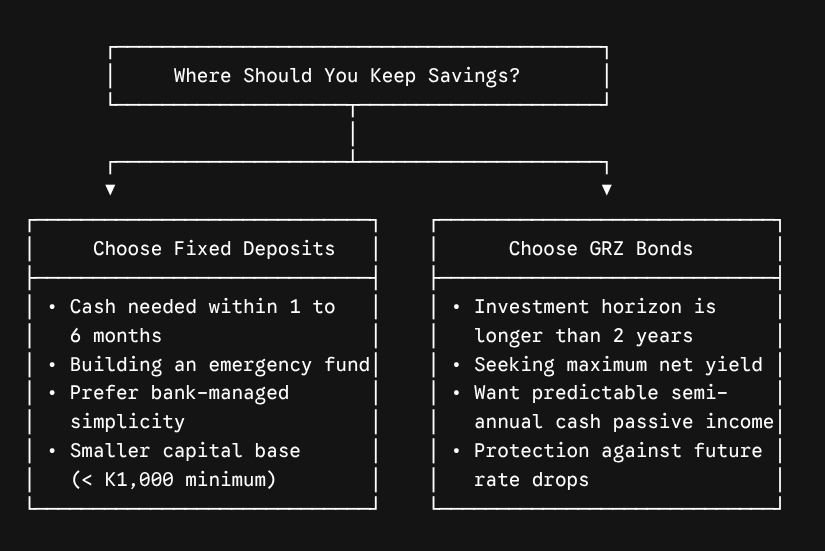
Strategy Recommendation: The Hybrid Approach
Most successful investors in Zambia do not choose exclusively one or the other. Instead, they ladder their savings:
- Keep 20%–30% in Fixed Deposits or High-Yield Savings Accounts: Serves as your liquid emergency cushion to cover short-term operational expenses without incurring bond sale delays.
- Deploy 70%–80% into GRZ Bonds and Treasury Bills: Locks in high single- or double-digit net passive income to beat consumer inflation over 2 to 15 years.