Investment clubs, chilimba groups, and Savings and Credit Co-operative Societies (SACCOs) across Zambia are increasingly moving away from sitting on idle cash in low-yield commercial accounts. Pooling member contributions to buy Bank of Zambia (BoZ) Treasury Bills and GRZ Bonds offers a low-risk way to lock in predictable, high-yielding returns—protecting group capital from inflation and providing regular payouts to fund member loans or annual dividends.
However, because investment clubs and SACCOs are recognized as group entities, the onboarding and operational process differs slightly from individual investors.
1. Regulatory Framework & Prerequisites
Unlike individual investors who simply submit a single National Registration Card (NRC), group entities must satisfy legal identification requirements under the Anti-Money Laundering (AML) framework.
Legal Structure Requirements
Before opening a Central Securities Depository (CSD) account at the Bank of Zambia, your group must be registered under a recognized legal body:
| Entity Type | Registration Body | Primary Document Required |
| Investment Clubs / Village Banks | PACRA (Patents and Companies Registration Agency) | Certificate of Registration (as a Business Name or Company) |
| SACCOs & Cooperatives | Ministry of Small and Medium Enterprises Development | Certificate of Registration under the Cooperative Societies Act |
| Trusts / Associations | Ministry of Home Affairs / Registrar of Societies | Certificate of Incorporation / Registration |
2. Onboarding Steps for Group Entities
To participate in primary market auctions, your executive committee must complete registration on the Bank of Zambia CSD Investor Portal.
1.Open a Dedicated Corporate/Group Bank Account:Step 1.
Ensure your club or SACCO operates an active Kwacha commercial bank account held in the official registered name of the entity (not in an individual executive member’s personal account).
2.Obtain an Entity TPIN:Step 2.
Apply for a dedicated Tax Payer Identification Number (TPIN) for the entity from the Zambia Revenue Authority (ZRA).
3.Pass a Formal Investment Resolution:Step 3.
Draft and sign official board/committee minutes authorizing the entity to invest in Government Securities. This document must explicitly name the designated authorized signatories who are permitted to place bids and operate the account.
4.Register on the BoZ CSD Portal:Step 4.
Select Corporate / Institutional Investor on the portal. Upload certified copies of:
- PACRA/Cooperative Registration Certificate
- Entity ZRA TPIN Certificate
- Signed Executive Resolution Minutes
- Certified NRCs and TPINs of all authorized bank signatories
- Proof of the group’s bank account (Official statement or bank confirmation letter)
3. Designing a Yield Strategy for Group Capital
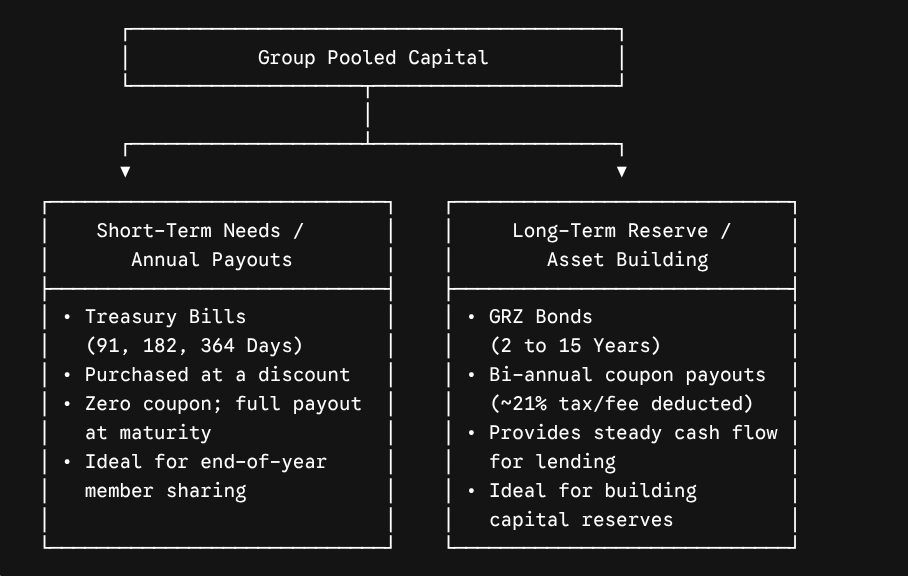
Clubs and SACCOs have distinct cash flow requirements depending on their operational cycles. Matching the right sovereign security to your group’s timeline is key:
Strategy A: Treasury Bills for Annual Member Payouts
If your club distributes profits or member savings at the end of every 12 months, 364-Day Treasury Bills are the preferred vehicle. You purchase the paper at a discount upfront and receive the full face value at maturity, matching your annual distribution cycle perfectly.
Strategy B: GRZ Bonds for SACCO Liquidity & Revolving Credit
SACCOs that issue loans to members can use long-term GRZ Bonds (e.g., 5-year or 10-year) as a cash-flow engine. The bi-annual net coupon payments (paid every six months) provide a predictable stream of fresh liquidity that can be injected straight back into the SACCO’s revolving credit pool.
4. Bidding Limits and Tax Considerations
- Bidding Thresholds: Groups bidding under K300,000 submit Non-Competitive Bids, taking the market-determined average yield rate. Groups placing K300,000 or higher can place Competitive Bids to specify their desired yield rate.
- Withholding Tax (WHT): Interest earned by clubs and SACCOs is subject to the standard 20% Withholding Tax and 1% BoZ handling fee deducted at source.
- Accounting & Distributions: Because WHT is deducted at source by the central bank before cash hits your account, the funds received by your treasurer represent net earnings, making annual dividend distribution calculations straightforward.
For a practical breakdown of how group pooling strategies work for Zambian investment clubs, watch Should Your Village Banking Group Invest in GRZ Bonds? to see how collective capital can unlock high-yielding government securities while managing group liquidity.