Building a high-yielding local currency investment portfolio in Zambia requires choosing the right mix of fixed income and equity instruments. For long-term investors, the choice usually comes down to two flagship asset classes: Government of the Republic of Zambia (GRZ) Bonds and stocks listed on the Lusaka Securities Exchange (LuSE).
While both instruments allow you to grow local capital, they operate on completely different risk-return mechanics. GRZ Bonds offer high, predictable cash flows backed by sovereign power, while LuSE equities offer dividend income and long-term capital appreciation tied to corporate performance.
This guide provides a comprehensive breakdown of GRZ Bonds versus LuSE stocks across risk profile, return potential, taxation, cash flow structure, and portfolio allocation strategies.
Quick Comparison Summary
| Feature | GRZ Government Bonds | LuSE Stocks (Equities) |
|---|---|---|
| Asset Class | Fixed Income (Sovereign Debt) | Ownership Equity (Corporate Shares) |
| Primary Income Stream | Bi-annual Coupon Payments (Fixed Rate) | Annual/Bi-annual Dividends + Price Gains |
| Current Yield Profile | ~14% to 18%+ p.a. (Locked for full term) | Variable Dividend Yields (Typically 5%–12%) |
| Capital Appreciation | None if held to maturity (Redeemed at Par) | Unlimited potential (Driven by company growth) |
| Risk Profile | Low (Sovereign credit risk) | Medium to High (Market & corporate credit risk) |
| Taxation | 20% Withholding Tax + 1% BoZ Fee | Property Transfer Tax (PTT) / Dividend WHT exempt for listed stocks |
| Inflation Protection | Moderate (Fixed coupon yields) | High (Companies adjust pricing with inflation) |
1. Income Structure: Fixed Cash Flows vs. Variable Growth
Understanding how each asset class generates cash returns is essential for matching your financial goals.
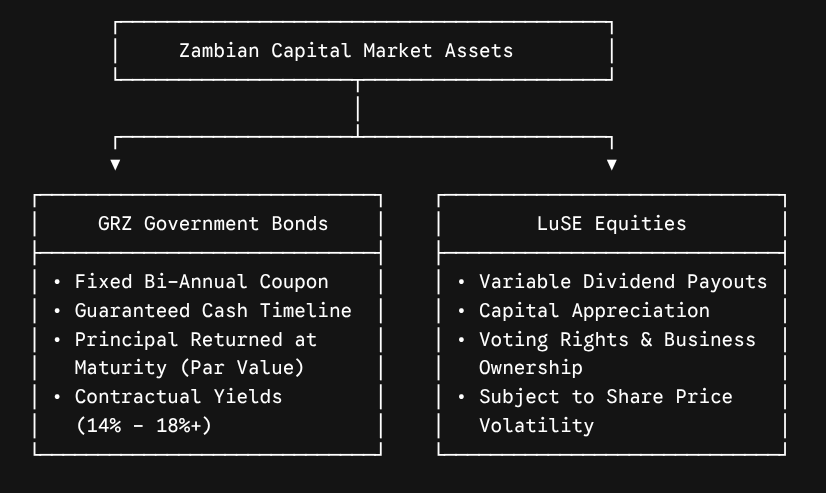
GRZ Bonds: Predictable Contractual Yields
When you buy a GRZ Bond, you are lending money to the central government. The interest rate (coupon) is fixed at auction and paid out every six months until maturity (2, 3, 5, 10, or 15 years).
- Example: On a K100,000 investment in a 10-year GRZ Bond with a 16.5% coupon, you earn a gross coupon of K16,500 per year (K8,250 every six months), regardless of broader market fluctuations.
LuSE Stocks: Cash Dividends + Capital Growth
When you buy shares in companies like Copperbelt Energy Corporation (CEC), Airtel Networks Zambia, or Zanaco, you become a co-owner. You earn money in two ways:
- Dividend Yield: Cash payments declared by the board out of annual profits.
- Capital Gains: An increase in share price over time as the business expands its operations and earnings.
2. Tax Efficiency: The Hidden LuSE Advantage
One major factor that tilts the scale toward LuSE equities is tax treatment under Zambian law.
Tax Breakdown
- GRZ Bonds: Subject to a 20% Withholding Tax (WHT) on interest earnings plus a 1% Bank of Zambia handling fee (totaling ~21% deducted at source).
- LuSE Listed Equities: Enjoy significant tax incentives designed to encourage public market participation:
- 0% Dividend Withholding Tax on dividends paid by companies listed on the official list of the LuSE.
- Exempt from Property Transfer Tax (PTT) on share transfers executed on the exchange.
- Exempt from Capital Gains Tax on share price appreciation.
Worked Calculation: K250,000 Investment
Let’s compare a 17.5% GRZ Bond against a LuSE Stock offering a 12.5% Dividend Yield:
Option A: K250,000 in a 17.5% GRZ Bond
- Gross Annual Return: K250,000 * 17.5% = K43,750 (Gross Annual Return)
- Less 21% Tax & Handling Fee: K43,750 * 21% = K9,187.50 (Tax & Handling Fee)
- Net Annual Cash Received: K43,750 – K9,187.50 = K34,562.50 (Effective Net Rate: 13.83%)
Option B: K250,000 in a 12.5% Dividend-Yielding LuSE Stock
- Gross Dividend Income: K250,000 * 12.5% = K31,250 (Gross Dividend Income)
- Less Dividend WHT (LuSE Exemption): K0
- Net Annual Cash Received: K31,250 – K0 = K31,250 (Effective Net Rate: 12.50%)
Takeaway: Even though the stock’s gross dividend yield (12.5%) is lower than the bond’s gross coupon (17.5%), the 0% dividend tax on LuSE stocks closes the gap dramatically. The bond brings in K3,312.50 more net cash per year, but the stock leaves the investor with zero tax burden plus full exposure to long-term share price growth.
3. Inflation Protection and Re-Investment Risk
The long-term performance of your capital depends heavily on how well your assets keep pace with local inflation:
Fixed Bond Yields:    Static Nominal Coupon  ---> Inflation Eats Purchasing Power Over Time
LuSE Stock Holdings: Earnings & Asset Values ---> Rise Along with Consumer Price Levels- GRZ Bonds (Inflation Exposure): Because bond coupon payouts are fixed, a sustained surge in domestic inflation reduces the purchasing power of your bi-annual cash payouts. Furthermore, if you lock into a 15-year bond today, your principal repayment at maturity will remain at the original face value.
- LuSE Stocks (Inflation Hedge): Well-managed listed companies (especially utilities, telecom, and consumer staples) periodically raise their product prices alongside inflation. As company revenues and profits increase with inflation, their dividend distributions and underlying stock valuations tend to expand accordingly.
4. Risk Profile & Volatility
Credit Risk
- GRZ Bonds: Backed by the sovereign authority of Zambia. Local currency bond defaults are rare because the central bank issues debt denominated in Kwacha.
- LuSE Stocks: Exposed to corporate solvency and macroeconomic conditions. If a listed firm faces operational disruption or declining revenue, dividends can be slashed or suspended entirely.
Liquidity Risk
- GRZ Bonds: Primary auctions run monthly for bonds, and secondary market trading is accessible through commercial banks and registered brokers.
- LuSE Stocks: The Lusaka Securities Exchange is a frontier market with relatively low daily trading volumes compared to global exchanges. Selling large blocks of shares quickly without affecting the prevailing market price requires patient execution through a licensed stockbroker.
Portfolio Strategy: How to Balance Bonds and Stocks
Rather than viewing GRZ Bonds and LuSE stocks as competing choices, top institutional funds and private wealth managers build a barbell strategy:
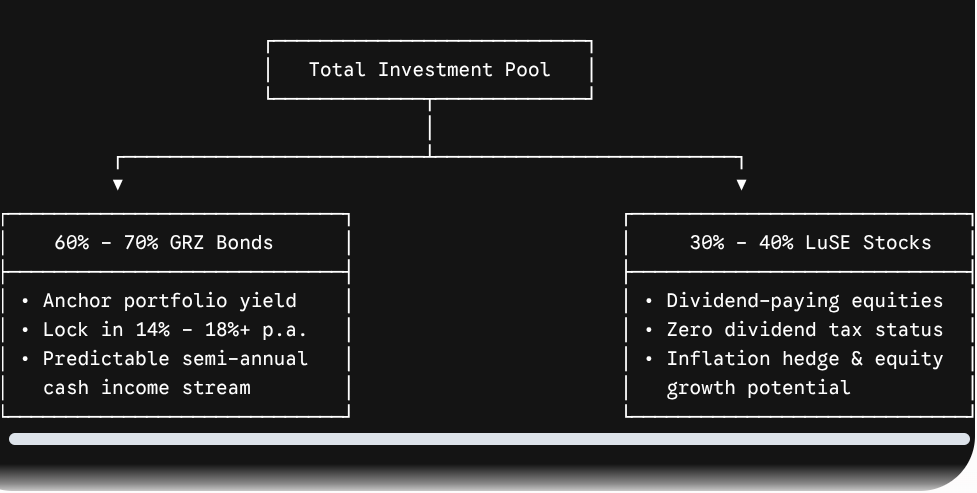
- Use GRZ Bonds for Baseline Income: Allocate 60%–70% of your long-term capital into 5-year or 10-year GRZ Bonds to establish a predictable, high-yield cash flow engine that covers your baseline living or reinvestment needs.
- Use LuSE Equities for Growth & Tax Savings: Allocate 30%–40% into dividend-paying LuSE blue-chip stocks. This portion provides tax-free dividend income, hedges your portfolio against inflation, and captures long-term corporate growth.