For income-focused investors in Zambia, Government of the Republic of Zambia (GRZ) bonds are among the most popular fixed-income instruments available. Unlike Treasury Bills—which are short-term, zero-coupon investments bought at a discount—GRZ bonds are long-term debt instruments that pay regular, predictable interest.
These interest payments are called coupons. Understanding how coupon rates are calculated, when they arrive, and how taxes impact your net cash flow is essential for building an effective income portfolio.
What is a GRZ Bond Coupon?
A coupon is the annualized interest rate promised by the government when a bond is issued. This rate remains fixed for the entire duration (tenor) of the bond, whether you hold a 2-year, 5-year, 10-year, or 15-year paper.
- Fixed Rate: If you purchase a 10-year GRZ bond with a 16.0% nominal coupon rate, you will earn 16% of your face value per year, every year, until maturity.
- Face Value vs. Investment Cost: The coupon percentage is always calculated against the face value (par value) of the bond you purchased, not necessarily the exact discounted or premium price you paid during the Bank of Zambia (BoZ) auction.
How Often Do You Get Paid? (The Payment Schedule)
GRZ bonds pay interest semi-annually (twice a year).
Your annual coupon is split into two equal 50% installments, paid exactly six months apart from the issue date of the bond.
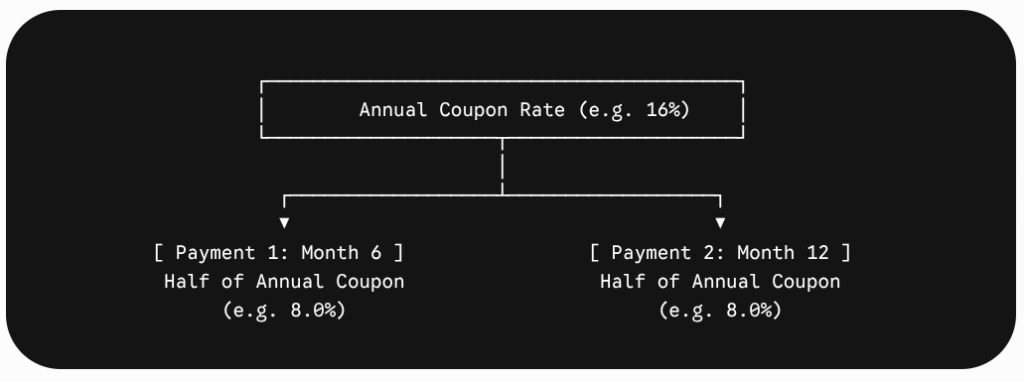
Example Payment Timeline:
If you purchase a 10-year bond issued on March 15th:
- First Coupon Payment: September 15th (8.0% of face value)
- Second Coupon Payment: March 15th of the following year (8.0% of face value)
- Repeat: This cycle continues twice a year for 10 years until the bond reaches its maturity date, at which point your principal is returned alongside the final coupon.
Calculating Your Net Cash Collection: Taxes & Fees
The nominal coupon rate is the gross figure. Before the cash hits your bank account, two standard deductions are applied at source by the Bank of Zambia:
| Deduction Type | Rate / Percentage | Description |
| Withholding Tax (WHT) | 20% | Standard government tax levied on investment interest income in Zambia. |
| BoZ Handling Fee | 1% | Central bank administrative charge applied to the coupon payout. |
Because these fees total roughly 21% of your gross coupon value, your net cash payout is approximately 79% of the gross interest earned.
Worked Example: Calculating Your Bi-Annual Income
Let’s say you hold K100,000 Face Value in a 15-year GRZ Bond with a 17.50% nominal coupon rate.
Step 1: Calculate Gross Annual & Semi-Annual Income
- Gross Annual Coupon: K100,000×17.50% = K17,500 per year.
- Gross Semi-Annual Payment: K17,500 ÷ 2 = K8,750 every 6 months.
Step 2: Apply Taxes and Bank Fees
- Withholding Tax (20%): 20% × K8,750 = K1,750
- BoZ Handling Fee (1%): 1% × K8,750 = K87.50
- Total Deductions: K1,750 + K87.50 = K1,837.50
Step 3: Calculate Your Net Cash Payout
Net Bi-Annual Coupon = K8,750 − K1,837.50 = K6,912.50
The Takeaway: For a K100,000 bond at 17.50%, you will receive K6,912.50 directly into your bank account twice a year, resulting in an effective net annual yield of 13.825%.
How Are Payments Delivered?
You do not need to claim or invoice the Bank of Zambia when a coupon payment date arrives.
- Automated Settlement: On the scheduled payment date, the BoZ Central Securities Depository (CSD) system automatically processes the net payment.
- Direct Credit: Funds are deposited directly into the commercial bank account linked to your CSD profile via Direct Debit / RTGS.
- Notification: You receive a payment advice notification via email confirming the gross coupon, tax deductions, and net amount disbursed.
Inflation Caution: While nominal coupon payments provide predictable cash flows, remember that high consumer price inflation erodes real purchasing power over time. To preserve capital growth, many investors reinvest their bi-annual coupon payouts into short-term Treasury Bills or additional bond auctions to compound their returns.