With high nominal yields on Zambian government securities—often reaching 15% to 18%+ on benchmark tenors—offshore institutional and retail investors frequently turn to Government of the Republic of Zambia (GRZ) bonds and Treasury Bills (T-Bills) in search of yield.
While Zambia’s regulatory framework for capital flows is among the most open in Sub-Saharan Africa, foreign portfolio investment (FPI) comes with specific operational prerequisites and structural risks that non-resident investors must navigate.
1. Regulatory Framework & Eligibility for Offshore Investors
Zambia imposes no legal restrictions on non-resident participation in its sovereign debt auctions. Foreign individuals, corporate entities, and institutional fund managers are fully eligible to purchase both short-term T-Bills and long-term GRZ Bonds.
Key Regulatory Mandates
- Open Capital Account: Zambia operates an open capital account with no exchange controls restricting the repatriation of dividends, coupon interest, or principal redemptions. Funds convert freely through commercial banking channels at prevailing market exchange rates.
- The “Kwacha Only” Rule: Under Bank of Zambia currency regulations, all domestic financial transactions, security purchases, coupon payouts, and principal redemptions must be denominated and settled in Zambian Kwacha (ZMW). Offshore investors cannot settle directly in foreign currency (USD/EUR/GBP).
- Central Securities Depository (CSD): All ownership records are digitized and held directly at the Bank of Zambia (BoZ) CSD.
2. Onboarding Requirements for Foreign Investors
While offshore entities can participate in primary auctions, they must fulfill two non-negotiable operational requirements before placing a bid:
| Requirement | Details for Offshore Investors |
| Local Kwacha Bank Account | Non-residents must open a Kwacha-denominated bank account with a commercial bank registered in Zambia (e.g., Stanbic, Standard Chartered, Absa, Zanaco). Settlement funds for purchases are debited here, and coupon payouts are credited directly to this account. |
| BoZ CSD Registration | Investors must register on the Bank of Zambia Investor Portal. Non-resident applications require certified passport copies, corporate registration documents (for entities), proof of bank account, and a Zambian Tax Payer Identification Number (TPIN) issued by the Zambia Revenue Authority (ZRA). |
Custody Consideration: Large institutional investors frequently utilize custodian banks (such as Standard Chartered or Stanbic) to manage local CSD registration, trade settlement, and foreign currency conversion on their behalf via nominee structures.
3. Taxation & Deduction at Source
Understanding net cash flow requires factoring in statutory deductions applied at source on all coupon payments:
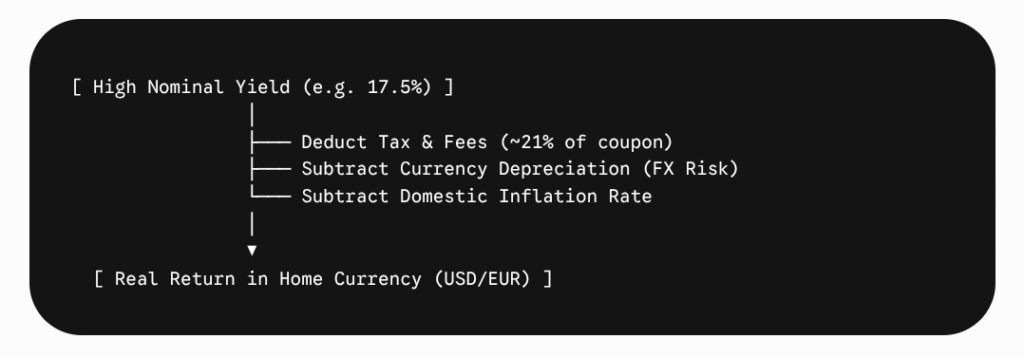
Net Payout = Gross Coupon − Withholding Tax (20%) − BoZ Handling Fee (1%)
- Withholding Tax (WHT): A final 20% tax is automatically withheld at source from every gross coupon payment.
- BoZ Handling Fee: A 1% administrative fee is deducted per coupon disbursement.
- Double Taxation Agreements (DTAs): If your primary tax residence is in a country with an active DTA with Zambia, reduced WHT rates may apply through proper tax filings with the ZRA.
4. Key Risks for Offshore Bond Buyers
While high nominal rates are appealing, foreign investors face critical structural and macroeconomic risks:
Risk 1: Forex Volatility & Currency Depreciation
Because bonds are issued and paid in Zambian Kwacha (ZMW), currency volatility is the single greatest risk for foreign investors.
- If the Kwacha depreciates against the US Dollar by 15% in a year, a 16% gross Kwacha coupon yield is virtually wiped out when converted back into USD.
- Kwacha performance is heavily correlated with international copper prices (Zambia’s primary export) and global risk-on/risk-off sentiment toward emerging markets.
Risk 2: Liquidity & Secondary Market Constraints
Unlike major sovereign bond markets, local-currency debt in Zambia is primarily a hold-to-maturity market.
- You cannot redeem a GRZ bond at the Bank of Zambia prior to its maturity date.
- If an offshore investor needs to exit a position early, the bond must be sold on the secondary market via local commercial banks or licensed stockbrokers on the Lusaka Securities Exchange (LuSE). Secondary market liquidity can fluctuate, and selling large blocks during market stress may require discounting the bond price.
Risk 3: Transfer & Conversion Forex Availability
While there are no legal restrictions on capital repatriation, period-specific liquidity tightness in the domestic interbank foreign exchange market can occasionally cause short delays when converting large amounts of Kwacha proceeds back into hard currency.
Strategic Summary for Foreign Buyers
Foreign portfolio investors can achieve attractive risk-adjusted returns in Zambian debt markets, provided they structure their entry properly:
- Work with an experienced local custodian bank to streamline CSD account registration and foreign exchange execution.
- Focus on benchmark tenors (7-year, 10-year, and 15-year bonds) which offer the deepest secondary market liquidity and regular re-openings by the Bank of Zambia.
- Factor currency conversion costs and statutory tax deductions (effective ~21% coupon deduction) into yield-to-maturity calculations before placing competitive auction bids.