Taxation in Zambia: The Definitive Guide to ZRA Compliance, Statutory Tariffs, and Corporate Frameworks
A clear understanding of the tax system is essential for financial planning and operational compliance in Zambia. Under the administration of the Zambia Revenue Authority (ZRA), the country operates a source-based tax system. This means both individuals and corporate bodies are primarily liable for tax on income generated, or deemed to be generated, from sources within the borders of Zambia.
The regulatory landscape is governed by the Income Tax Act (Chapter 323 of the Laws of Zambia), supplemented by annual legislative amendments passed through national budget cycles. Recent policy overhauls aim to broaden the tax base, digitize compliance, and stimulate private sector investment while curbing tax evasion and aggressive transfer pricing.
For individual wage earners, micro-entrepreneurs, and multinational corporate entities alike, strict alignment with ZRA’s statutory timelines and tax structures is vital to protect profit margins and avoid severe administrative penalties.
1. The Core Tiers of Zambia’s Revenue Framework
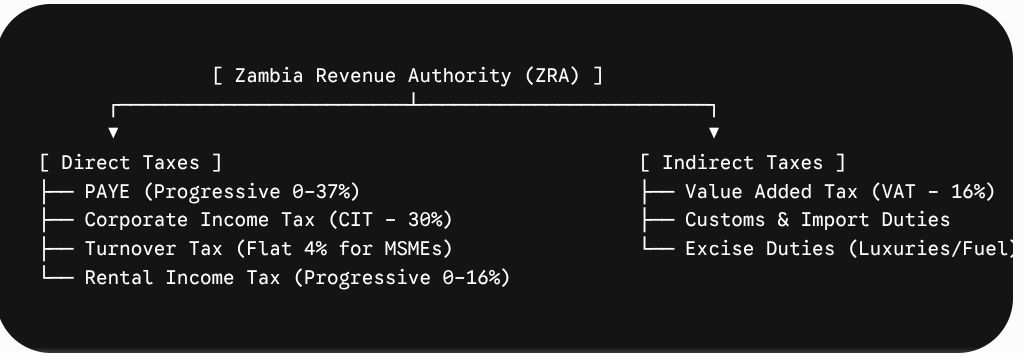
The domestic tax architecture in Zambia is divided into direct and indirect taxes, each governed by specific filing rules, rates, and target demographics.
Pay-As-You-Earn (PAYE)
PAYE is a progressive direct tax levied on the employment emoluments of individuals. Employers bear the statutory obligation to deduct PAYE at source on behalf of all formal employees earning above the tax-free threshold. Deducted taxes must be remitted to the ZRA on or before the 10th day of the month following the payroll run.
Corporate Income Tax (CIT)
CIT is charged on the net adjusted taxable profits of registered corporate entities during their charge year. While the standard baseline corporate tax rate is highly competitive, specialized economic sectors enjoy concessional rates, while others face elevated rates to capture resource rents.
Value Added Tax (VAT)
An indirect consumption tax placed on the supply of taxable goods and services in Zambia, as well as on taxable imports. Standard-rated transactions require registered businesses to act as collection agents. Mandatory VAT registration is triggered automatically when a business’s taxable turnover reaches or exceeds K800,000 per annum.
Turnover Tax (TOT)
To simplify compliance for Micro, Small, and Medium Enterprises (MSMEs), the ZRA administers a Turnover Tax regime. Businesses generating K800,000 or less in annual gross turnover pay tax on their gross receipts rather than net profits, removing the overhead cost of maintaining complex audited accounts.
2. Statutory Personal Income Tax (PAYE) Brackets
Zambia applies a progressive tax structure to individual income. This guarantees that lower-income earners are protected by a generous tax-free buffer, while higher increments of income are taxed sequentially at increasing percentages.
The Monthly PAYE Bands
The standard monthly PAYE brackets are structured as follows:
| Monthly Taxable Income Range (ZMW) | Applicable Tax Rate |
| First K5,100 | 0% (Tax-Free Threshold) |
| Next K2,000 (K5,101 to K7,100) | 20% |
| Next K2,100 (K7,101 to K9,200) | 30% |
| Above K9,200 | 37% |
The Annual PAYE Bands
For year-end individual assessments and tax reconciliation, the annual brackets align proportionally:
| Annual Taxable Income Range (ZMW) | Applicable Tax Rate |
| Up to K61,200 | 0% |
| K61,201 to K85,200 | 20% |
| K85,201 to K110,400 | 30% |
| Above K110,400 | 37% |
Understanding the Pre-Tax Deduction Rule
Before applying the PAYE brackets to an employee’s gross monthly salary, certain statutory pension deductions are subtracted to arrive at the net “taxable income” base. Specifically, the employee’s 5% NAPSA pension contribution is fully tax-deductible and must be removed first.
Important Distinction: National Health Insurance (NHIMA) employee contributions (1%) are not tax-deductible. They are calculated on gross salary but do not reduce the taxable income base for PAYE.
3. Corporate and Asset Taxation Matrix
While the baseline Corporate Income Tax (CIT) rate is set at 30%, the Income Tax Act provides specialized rates for specific economic sectors to drive targeted national growth:
| Corporate Category / Asset Type | Applicable Tax Rate | Policy / Operational Context |
| Standard Corporate Income | 30% | Default rate for non-specialized incorporated businesses. |
| Farming and Agro-Processing | 10% | Concessional rate designed to support food security and exports. |
| Non-Traditional Exports (NTEs) | 15% | Promotional rate for export-oriented manufacturing and non-mining goods. |
| Telecommunications | 35% | Elevated rate applied uniformly to highly profitable telecom networks. |
| Lusaka Stock Exchange Listed (LuSE) | 28% | A 2% rebate applies to encourage local equity listing and public ownership. |
| Turnover Tax (Gross Sales ≤ K800,000) | 4% | Simplified compliance; calculated on gross monthly revenue. |
Rental Income Tax
Income derived from letting out real estate is subject to withholding and direct filing taxes. The rate structures are split by annual gross rental turnover:
- Below K12,000 per annum: 0%.
- Between K12,000 and K800,000 per annum: 4% flat on gross rental receipts.
- Above K800,000 per annum: 16% flat on gross rental receipts.
Property Transfer Tax (PTT)
PTT is levied on the transfer of ownership of specified assets within Zambia. The tax is payable by the transferor (seller) and is calculated on the “realised value” (typically the market value or contract price, whichever is higher):
- Real Property (Land, Buildings): 8%.
- Shares in Zambian-incorporated companies: 8%.
- Mining Rights (Mining and Exploration Licenses): 10%.
- Intellectual Property (Patents, Trademarks): 8%.
4. Advanced Corporate Tax Limitations and Trade Logistics
Operating a mid-to-large scale business in Zambia requires aligning with advanced corporate anti-avoidance laws, mineral extraction regimes, and trade rules.
Interest Deduction Limitation (Thin Capitalization)
To prevent multinational corporations from shifting profits out of Zambia via excessive inter-company debt financing, the country enforces an EBITDA-based interest limitation rule.
- The deductibility of gross interest expenses is strictly capped at 30% of EBITDA (Earnings Before Interest, Tax, Depreciation, and Amortisation).
- Any excess interest expense that exceeds this 30% ceiling is disallowed in the current tax year but can be carried forward indefinitely to subsequent years.
Mineral Royalty Tax (MRT)
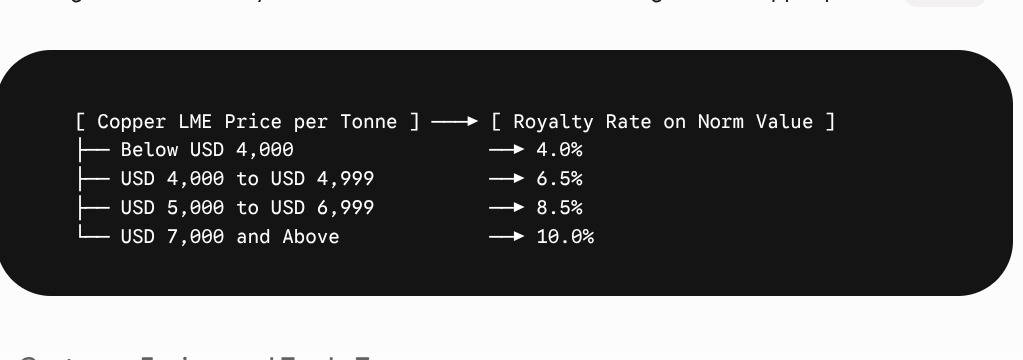
Mining companies are subject to MRT, which is calculated based on the market value of the minerals produced. Crucially, mineral royalties are fully tax-deductible when calculating Corporate Income Tax (CIT).
For copper—the backbone of Zambia’s mining sector—royalties operate on a progressive sliding scale tied directly to international London Metal Exchange (LME) copper prices:
Customs, Excise, and Trade Taxes
Imports entering Zambia are subject to a clear tariff structure managed by ZRA’s Customs Services Division:
- Customs Duty: Standard categories are rated at 0% (raw materials), 15% (intermediate goods), and 25% (finished consumer products) to protect domestic manufacturing industries.
- Excise Duty: Imposed on specific commodities like fuel, alcohol, tobacco, cosmetics, and luxury vehicles, with rates varying depending on environmental or public health impacts.
- Import VAT: Calculated at the standard 16% on the Taxable Value of Importation (which includes the customs value plus customs duty and excise duty).
5. The Comprehensive Payroll Deduction Stack
When structuring employee compensation, employers must account for the full suite of statutory obligations. The table below outlines the dual contribution liabilities of both employees and employers:
| Deduction / Levy Type | paid by Employee | paid by Employer | statutory Rate / Cap |
| PAYE | Progressive (0% to 37%) | Nil | No cap; calculated on taxable income base. |
| NAPSA Pension | 5% of gross earnings | 5% of gross earnings | Capped monthly based on the national insurable ceiling. |
| NHIMA Health Insurance | 1% of gross earnings | 1% of gross earnings | No cap; mandatory for all formal employees. |
| Skills Development Levy (SDL) | Nil | 0.5% of total gross payroll | Paid by the employer only; no cap applies. |
6. Step-by-Step Corporate Tax Compliance Lifecycle
To remain in perfect standing with the Zambia Revenue Authority and secure your vital Tax Clearance Certificate (TCC), you must adhere strictly to ZRA’s structured operational lifecycle.
1.Secure a Taxpayer Identification Number (TPIN):Step 1: Register.
Apply online through the ZRA portal to obtain your unique 10-digit TPIN. This acts as your master identification key across all government platforms, custom clearance entries, and banking systems.
2.Activate Applicable Tax Accounts:Step 2: Map Accounts.
Log into your ZRA portal profile and register for the specific tax types relevant to your operations. Select Turnover Tax if your revenue is K800,000 or below, or register for CIT, PAYE, and VAT if you cross standard thresholds.
3.Adopt the Smart Invoice System:Step 3: Integrate Smart Invoicing.
Ensure your billing software or point-of-sale system is fully integrated with the ZRA’s Smart Invoice system (Electronic Fiscal Devices/TIMS). Every transaction must generate an approved fiscal invoice to ensure valid VAT input tax deductions.
4.Establish Auditable Record Keeping:Step 4: Record keeping.
Maintain physical and digital records of all purchase receipts, sales books, import documents, payroll schedules, and bank statements for a minimum of six years. ZRA reserves the statutory right to audit these retrospectively.
5.Submit Statutory Returns Promptly:Step 5: File & Remit.
Submit monthly electronic declarations and clear balances before key statutory cutoffs:
- PAYE, WHT, & Turnover Tax: Due on or before the 10th of the following month.
- Value Added Tax (VAT): Due on or before the 18th of the following month.
- Annual Income Tax Return: Due by June 21st of the following year.
Frequently Asked Questions
What is the penalty for late tax filings or payments to ZRA?
Filing after the statutory deadline triggers immediate, automatic late filing penalties. For late payments, ZRA charges a one-time late payment penalty (usually 5% of the principal unpaid tax) plus daily compounding interest set at the prevailing Bank of Zambia policy rate plus an added margin.
Can a business deduct employee benefits from CIT?
Yes, standard business expenses—including staff salaries, employer pension contributions, and legitimate staff training expenses—are fully tax-deductible when computing Net Taxable Profit for Corporate Income Tax, provided they were incurred wholly and exclusively for the purposes of the business.
What is a Tax Clearance Certificate (TCC) and why is it required?
A TCC is an official document issued by the ZRA confirming that a taxpayer has no outstanding tax liabilities or unsubmitted returns. It is a mandatory prerequisite for bidding on government tenders, applying for business licenses, importing commercial goods, or securing corporate banking facilities.
Are foreign-sourced dividends taxable in Zambia?
Under Zambia’s source-based tax system, foreign-sourced dividend income is generally exempt from Zambian income tax. Only income generated or deemed to be generated from sources within the territory of Zambia falls within the local tax net.
Conclusion: Navigating Zambia’s Tax Landscape
The Zambian tax environment has evolved into a highly integrated, digital-first system designed to ensure transparency, simplify collection, and broaden the national revenue base. With the Zambia Revenue Authority (ZRA) consistently modernizing its online infrastructure and rolling out platforms like the Smart Invoice system, taxpayers now possess efficient tools to manage their accounts, submit declarations, and track statements in real time.
However, avoiding compliance risks requires active oversight. Managing your tax strategy effectively involves keeping three core principles in mind:
- Embrace Automation Early: Relying on automated payroll utilities and validated point-of-sale systems guarantees that statutory levies like PAYE, NAPSA, and NHIMA are calculated precisely, eliminating manual computation errors that lead to ZRA shortfalls.
- Proactively Track the Tax Calendar: Compliance failures rarely result from a lack of capital, but rather from missed dates. Missing monthly filing cutoffs triggers non-negotiable penalties and compounding interest that can quickly erode a business’s operational cash flow.
- Understand Your Specific Regime: Distinguishing between gross-based options like turnover tax and net-profit structures like corporate income tax prevents costly filing mistakes. Knowing when you cross the mandatory VAT threshold ensures you restructure your pricing models before penalties are applied.
Ultimately, staying compliant with ZRA guidelines is not simply a legal requirement—it is a distinct operational advantage. By maintaining meticulous transaction records, choosing the right structural classifications, and filing returns well ahead of deadlines, you protect your enterprise from sudden audits and build an unshakeable foundation for commercial growth.